

Primitive Futurism
Introduction to HATA Dome
The HATA Dome stands quietly at the edge of California‘s Sawtooth Mountains, its curved form emerging from the rocky terrain like a relic of both past and future. Designed and built by Anastasiya Dudik — a self-taught designer without formal architectural training — the structure is a gesture toward resilience, intuition, and an architecture that grows out of landscape and circumstance rather than trend.
Embracing what Dudik calls a ‘future primitive’ sensibility, the architecture draws from ancestral forms and elemental materials to meet contemporary environmental demands. The dome’s form is a performative design decision. The thermal mass moderates temperature, its sealed envelope resists fire and earthquakes with a gesture that echoes the earth’s own curves. Shotcrete over rebar, wrapped in foam insulation, and finished in stucco, the structure evokes both the logic of survival and the poetry of shelter. The HATA Dome is available for rent as a holiday retreat through Airbnb — find the listing here.
images © Natasha Lee, Shannon Moss, Brandon Stanley
Reframing Brutalism
In California’s High Desert, the HATA Dome speaks a language of concrete, but softly. While its exterior silhouette nods to Brutalism and the monolithic legacy of Soviet-era design, Anastasiya Dudik reinterprets these precedents with empathy. The shell encloses a space of refuge, not imposition. Sixteen-foot ceilings soar, but the acoustics remain hushed. Natural light slides across plaster walls. Edges soften into curves. Even the furnishings, carved from boulders and integrated into the interior architecture, follow the same continuous gesture.
The dome’s form dissolves the familiar architectural boundaries of floor, wall, and object. Inside, there is no separation between the landscape and the home. It is a continuum of matter and space. The built-in furniture seems to rise organically from the ground. Niches emerge like eroded pockets. Even the circular saltwater pool outside mirrors the shape of the dome, drawing the eye back to the silhouette that anchors this sculptural oasis in the desert expanse.
Designer Anastasiya Dudik executed every aspect of the project — from structural engineering and material procurement to interior detailing — without a studio, a contractor, or a team. It’s a solitary vision made real, uncompromised by committee or convention. Her process, like the dome itself, reflects resilience: the capacity to adapt, endure, and self-define.
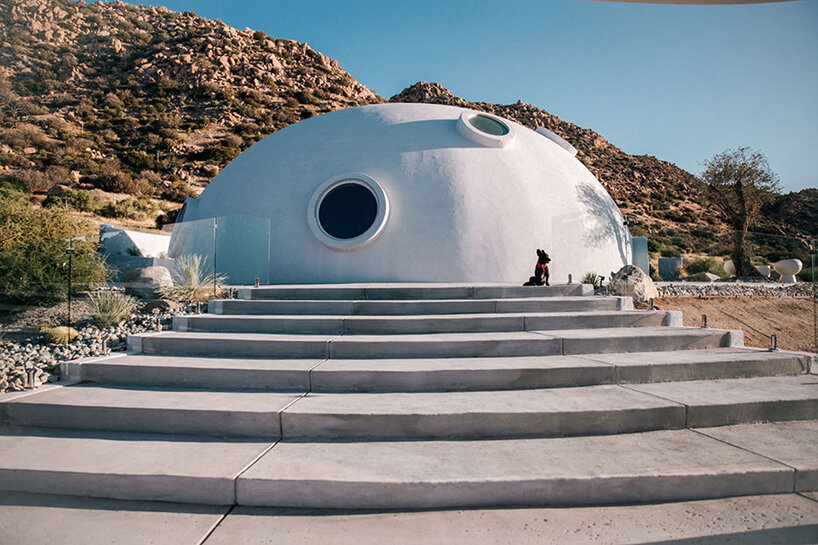
the monolithic concrete home is designed and built by Anastasiya Dudik
Living Within the Elements
The HATA Dome stands as a model of self-reliance in California. The structure’s thick concrete walls regulate internal temperatures, reducing dependence on artificial heating or cooling. With solar-ready systems, fire resistance, and durability against earthquakes and wind, it reimagines sustainability not as add-on, but as embedded logic. Its survivalist DNA does not exclude beauty. Instead, it makes room for it.
A familiar material palette of concrete, steel, stone is re-contextualized through personal memory. Dudik, who grew up surrounded by concrete structures in Ukraine, infuses the dome with a different emotional register. Where Brutalism once communicated austerity or control, here it becomes something protective and personal. A concrete dome becomes a kind of body that is resilient, curved, and embracing. Overall, the space invites a slowing down of time. From the acoustic hush to the careful modulation of light, the project encourages stillness and presence.
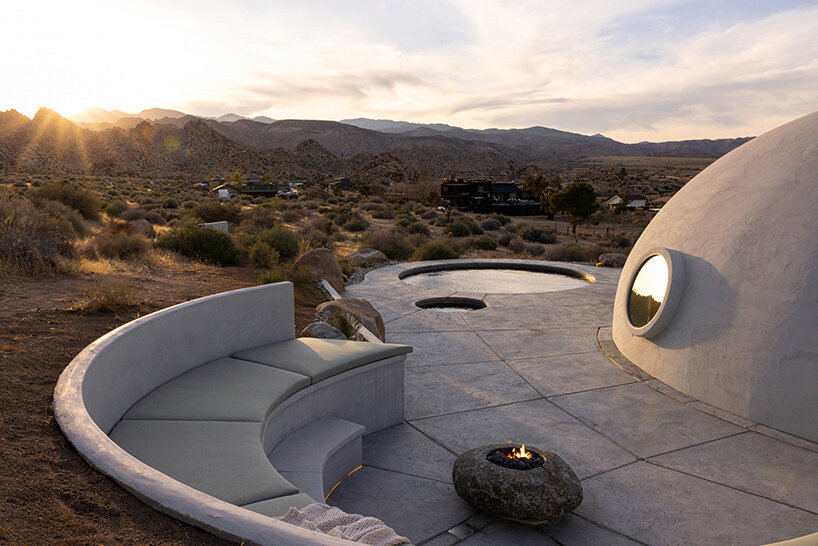
the HATA Dome reflects the designer’s Ukrainian roots and reclaims concrete as a poetic material
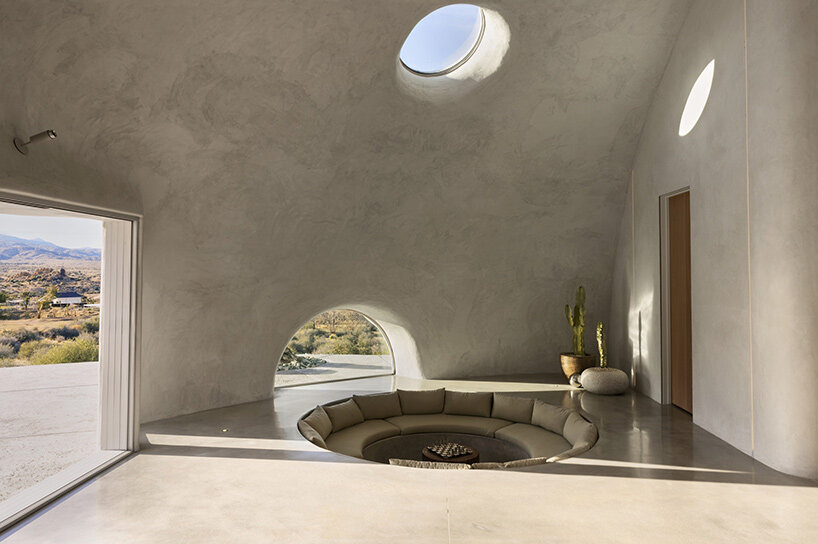
curved forms and thermal mass support off-grid and climate-resilient living
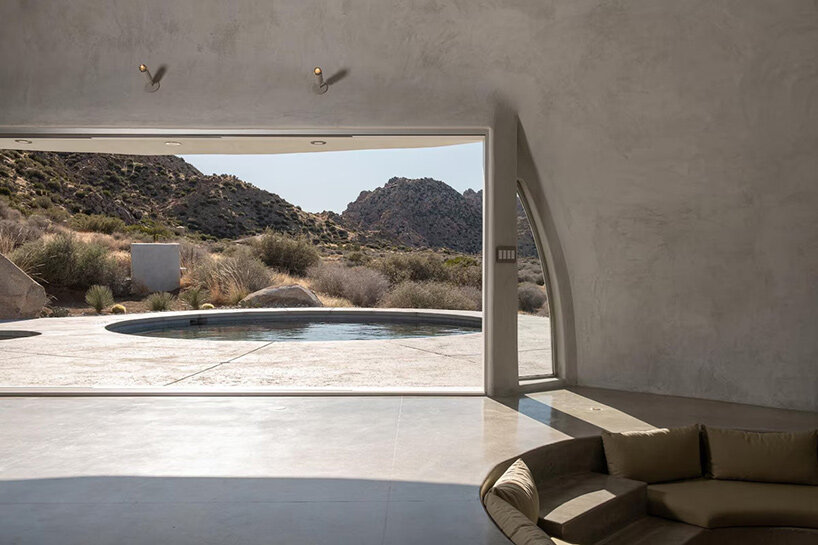
the dome is constructed with rebar shotcrete, foam insulation, and hand-applied stucco
Conclusion
In conclusion, the HATA Dome is a remarkable example of innovative design and sustainable living. Anastasiya Dudik’s vision for a ‘future primitive’ architecture has resulted in a unique and breathtaking structure that not only blends seamlessly into its surroundings but also provides a tranquil and self-sufficient living space. The dome’s curved form, thermal mass, and use of natural materials make it an exemplary model of eco-friendly design, while its beauty and poetic character invite occupants to slow down and appreciate the simplicity of life. As a holiday retreat, the HATA Dome offers a rare opportunity to experience the perfect


